Smart warranty triage on Service Cloud
Validating coverage at intake and routing claims in seconds — built for a large enterprise customer that was drowning in manual warranty triage.
The challenge
One of our large customer accounts was absorbing a high volume of warranty claims across email, web, and phone — and losing customers to slow responses. Every claim landed in a single shared queue. Agents had to manually look up the product, confirm whether it was still under warranty, decide whether it was a hardware or software issue, and route it to the right team before any real work began.
That manual triage added roughly 15 minutes to every case before a customer heard anything back. Claims for products already out of warranty consumed the same effort as valid ones. There was no validation at intake, no skills-based routing, and no self-service layer to absorb the repetitive "how do I reset my device" questions. The result was a rising backlog, inconsistent first-response times, and churn the account could measure.
The goal: validate warranty coverage the moment a case is created, route valid claims to the right specialist automatically, close out-of-warranty claims gracefully, and deflect common questions before they ever became cases.
Approach
Discovery & warranty data model
Mapped the existing claim lifecycle and built a clean asset-centric data model on standard objects — Account, Contact, Asset, and Case — with a Warranty_Claim__c object linking assets to cases and carrying SLA data. Asset holds the canonical Purchase_Date__c; Case carries Issue_Type__c. A case is only valid when its asset is active and within the coverage window.
Record-triggered warranty triage
The core of the build: an after-save, record-triggered Flow on Case. On creation it retrieves the parent asset, calculates remaining coverage in real time, and branches. Out-of-warranty claims are closed automatically with a templated, empathetic notice. In-warranty claims are validated and passed to routing. This single automation removed the manual triage decision entirely.
Skills-based Omni-Channel routing
Hardware failures route to a high-priority "Hardware Specialists" queue with a tighter SLA; software issues route to IT Support at standard priority. Presence-based load balancing means claims land with an available, appropriately skilled agent the first time — no re-assignment churn.
Unified agent console
Configured a Lightning Service Console so agents work from one screen: a utility bar with history, recent records, and Omni-Channel presence; related lists surfacing the asset and the account's claim history on the case; Dynamic Forms hiding irrelevant fields; and a guided Path across the case lifecycle with stage-specific tips.
Self-service deflection
Stood up an Experience Cloud portal where customers select their own registered asset, describe the issue, and track open claims in real time. An Einstein Bot captures initial details and deflects the most common requests, backed by a curated knowledge base of self-service articles — shifting low-level volume away from agents entirely.
How it fit together
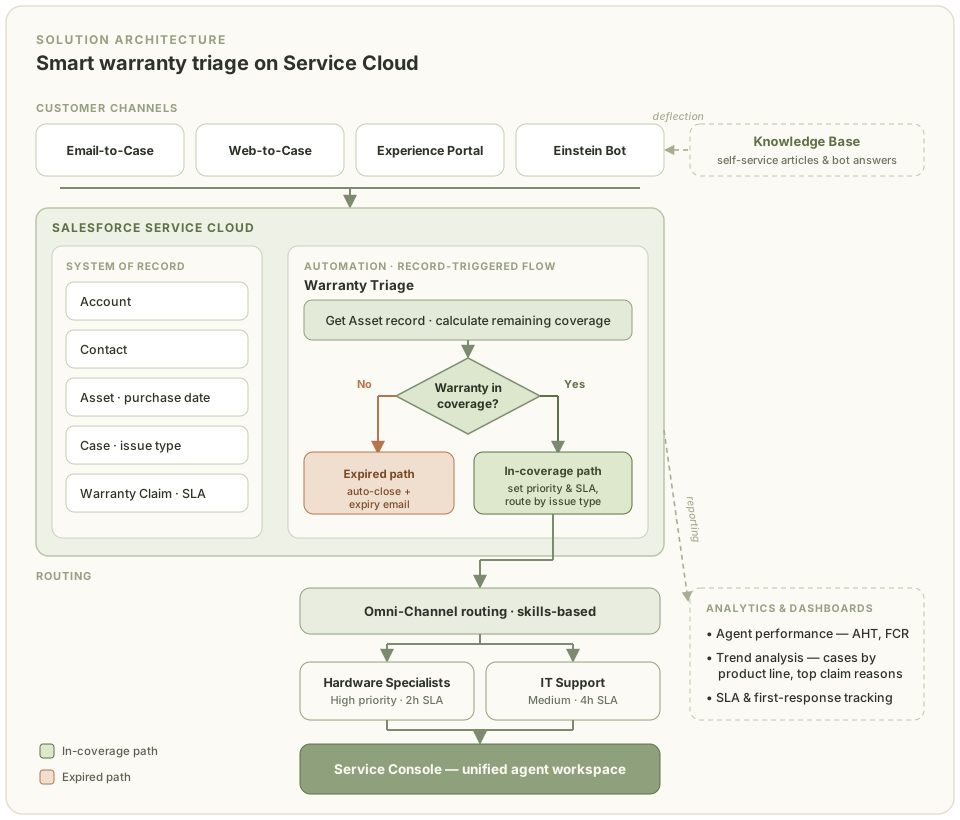
Service Cloud holds the canonical Account, Contact, Asset, and Case state. Warranty coverage is derived from asset data, so every channel reasons from the same source of truth.
Email-to-case, web-to-case, the customer portal, and the Einstein Bot all feed the same case model, then hand off to Omni-Channel for routing.
The record-triggered Flow validates coverage, closes expired claims, sets priority and SLA, and assigns the right queue — then fires the customer acknowledgment, all within seconds of case creation.
The Experience Cloud Help Center and knowledge base deflect common requests and let customers self-serve status, reducing inbound case volume.
Outcomes
- First-response time dropped from hours to minutes, with an automated, personalized acknowledgment sent the moment a valid claim is logged.
- Manual triage effort fell by roughly 40% — about 15 minutes saved per case — by automating the validate-and-route decision.
- Out-of-warranty claims close instantly with a clear, templated explanation, freeing agents to focus on covered cases.
- Self-service and bot deflection removed an estimated 30% of inbound case volume.
- CSAT improved as routing accuracy and first-contact resolution rose.
Tools & tech
Reflections
The leverage was not in any single feature — it was in validating warranty at the point of intake and removing the manual triage decision from the agent's plate. Once the asset data model was clean and trustworthy, the automation became reliable and everything downstream — routing, SLAs, reporting — fell into place. A no-code Flow carried the entire logic, which kept the solution maintainable by the account's own admins.