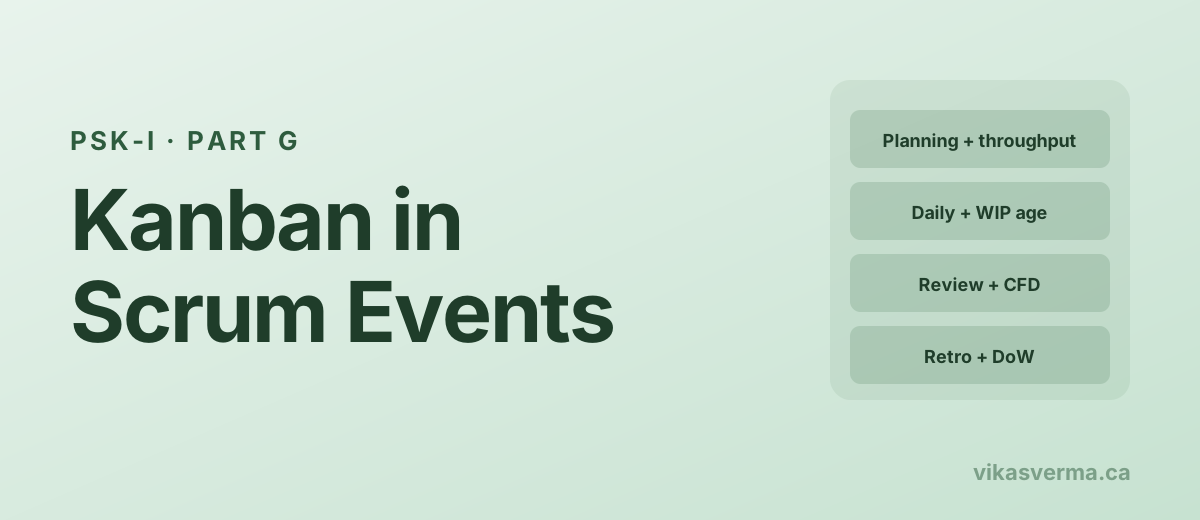
PSK-I Part G: Kanban in the Scrum Events
This is Part G of the PSK-I Exam Prep series. It covers how the Kanban practices and flow metrics integrate into Scrum’s five events — the integration layer the exam tests directly.
The overarching rule
Kanban adds no new events. Flow metrics strengthen empiricism inside the existing ones.
Teams deliver value at least once per Sprint (not “only once at the very end”). The Sprint itself is a coarse form of limiting WIP.
The most common trap across all of Part G: “Add a separate weekly metrics meeting.” → No. Kanban adds no events; use the existing ones.
G1. Sprint Planning with Flow
What changes. The team uses historical throughput to gauge realistic capacity, and the SLE to support achievable forecasts. The outputs of Sprint Planning are unchanged — a Sprint Goal and a plan.
Instead of guessing capacity from optimism or a fixed velocity target, the team looks at its actual throughput history: if it has averaged ~8 items/Sprint and that rate has been stable, it plans around that, leaving slack for variability.
How questions come.
- “What informs how much work the team forecasts at Planning?” → historical throughput (not gut feel, not a fixed velocity target).
- “Does Kanban change the output of Sprint Planning?” → No — Sprint Goal + plan, unchanged.
G2. Daily Scrum with Flow
What changes. The emphasis shifts to Current WIP and Work Item Age as the primary inputs. The mindset becomes “stop starting, start finishing.” The event remains 15 minutes, for the Developers, serving the Sprint Goal — nothing changes structurally.
The aging chart is the practical tool here: the team scans it, spots items approaching or exceeding the SLE line, and decides to swarm those items rather than start anything new.
Worked example. The team scans the aging chart, spots a 6-day item against an 8-day SLE, and decides to swarm it today rather than start a new item.
How questions come.
- “Most useful metrics at the Daily Scrum?” → WIP + Work Item Age.
- “Does Kanban change the Daily Scrum’s purpose?” → No — it still serves the Sprint Goal.
- “Who runs the Daily Scrum when using Kanban?” → Developers — unchanged.
G3. Sprint Review with Flow
What changes. In addition to inspecting the Increment, the team inspects flow — Cycle Time/Throughput trends and a CFD. Throughput + Monte Carlo may be used for “what by when” as projections, not commitments. The output is still an adapted Product Backlog.
Showing a CFD where the in-progress band widened opens a product backlog and process conversation about where value is stuck — and feeds directly into what should be prioritised next.
How questions come.
- “Which flow data is relevant at the Sprint Review?” → Cycle Time & Throughput trends (not individual hours or velocity).
- “Is a Monte Carlo forecast shown at the Review a commitment?” → No — a probabilistic projection.
G4. Sprint Retrospective with Flow
What changes. The Retrospective is where the team typically inspects and adapts the Definition of Workflow and WIP limits, reviewing WIP, cycle times, and throughput for improvement opportunities.
The DoW and WIP limits can be changed at any time — the Retrospective is just the natural cadence for doing so in a structured, team-agreed way.
Worked example. Seeing repeated SLE breaches in a particular column, the team lowers that column’s WIP limit and adds an explicit pull policy to the DoW during the Retrospective.
How questions come.
- “Where is the DoW usually adapted?” → the Retrospective.
- “Can the team change WIP limits mid-Sprint?” → Yes — the Retro is usual, but changes are allowed anytime.
G5. Refinement & the Sprint as WIP
What changes. Favour smaller, similar-sized items — they flow more predictably and sharpen throughput forecasts. This is the Kanban lens applied to how the backlog is shaped, not a new event.
The Sprint itself is also explicitly called out as a coarse form of limiting WIP — one of the conceptual bridges between Scrum and Kanban.
How questions come.
- “How does Kanban help refinement?” → smaller, similar-sized items improve flow predictability.
- “The Sprint is a form of ___.” → limiting WIP.
Summary: what changes vs what stays the same
| What changes | What stays the same | |
|---|---|---|
| Sprint Planning | Use throughput for capacity | Sprint Goal + plan as output |
| Daily Scrum | Focus on WIP + Work Item Age | 15 min, for Developers, serves Sprint Goal |
| Sprint Review | Inspect flow + CFD, Monte Carlo forecasts | Working session, adapts Product Backlog |
| Retrospective | Adapt DoW + WIP limits | Inspects individuals, interactions, process, tools, DoD |
| Refinement | Favour small, similar-sized items | Ongoing activity, no timebox |
Next: Part H — Exam Reasoning Patterns — the trap taxonomy, calculation shortcuts, tie-breakers, and exam-day tactics.