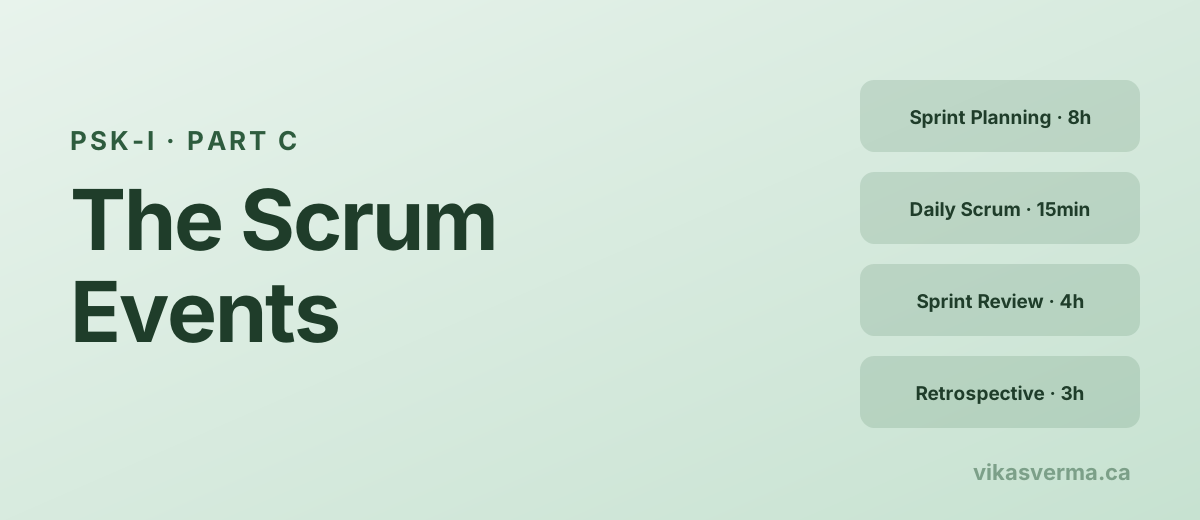
PSK-I Part C: The Scrum Events
This is Part C of the PSK-I Exam Prep series. It covers all five Scrum events in depth, including timeboxes and the PSK-specific flow additions.
Frame for all events. The Sprint is the container for the other four events. Each event is a formal inspect-and-adapt opportunity that reduces the need for meetings not defined in Scrum. Know the timeboxes cold.
C1. The Sprint
What it is. A fixed-length event of one month or less — “the heartbeat of Scrum, where ideas are turned into value.” The container for all other events.
How it works.
- A new Sprint starts immediately after the previous one ends. No gaps.
- During a Sprint: no changes that endanger the Sprint Goal; quality does not decrease; the Product Backlog is refined as needed; scope may be clarified and renegotiated with the PO as more is learned.
- The Sprint is itself a coarse form of limiting WIP — the bridge to Kanban.
Cancellation rules (exam favourite).
- Only the Product Owner can cancel a Sprint.
- Only valid reason: the Sprint Goal becomes obsolete.
- Cancellation is rare.
Misconception to avoid. “Extend the Sprint to finish the work.” No — scope can flex; the timebox cannot. A team running behind simply finishes the timebox, then carries unfinished work back to the Product Backlog.
Worked example. A company pivots away from the product line the current Sprint serves, making the Sprint Goal pointless. The Product Owner may cancel the Sprint. If instead the team is merely behind schedule, that is not grounds to cancel or extend.
How questions come.
- “Who can cancel a Sprint, and when?” → only the PO, when the Sprint Goal is obsolete.
- “The team is behind — extend the Sprint?” → No.
- “When does the next Sprint start?” → immediately after the previous ends.
C2. Sprint Planning
What it is. The event that initiates the Sprint by laying out the work. Timeboxed to ≤ 8 hours for a one-month Sprint (shorter for shorter Sprints).
The three topics.
| Topic | Question answered | Who leads |
|---|---|---|
| Why | Why is this Sprint valuable? (Sprint Goal) | Whole team |
| What | Which Product Backlog items to select? | Developers, with PO |
| How | How will the Increment be built? | Developers |
Output. A Sprint Backlog = Sprint Goal + selected items + plan.
With Kanban. Historical throughput informs capacity — replacing (or augmenting) gut feel or fixed velocity targets.
Misconception to avoid. “The PO assigns the work / sets capacity.” No — Developers decide capacity; the whole team crafts the Sprint Goal together.
Worked example. Planning starts with the PO framing the objective; the team shapes it into a Sprint Goal (“enable guest checkout”). The Developers, seeing they average ~9 items per Sprint from historical throughput, pull the items that serve the Goal and sketch the plan.
How questions come.
- “What are the three topics of Sprint Planning?” → Why / What / How.
- “Max timebox for a one-month Sprint?” → 8 hours.
- “What informs capacity in Scrum with Kanban?” → historical throughput.
C3. Daily Scrum
What it is. A 15-minute event for the Developers, each working day, to inspect progress toward the Sprint Goal and adapt the Sprint Backlog, adjusting the upcoming plan.
How it works.
- The Developers run it. PO and SM participate only if actively working on Sprint Backlog items.
- No required structure — the 2020 Guide removed the three-question format. Any format that meets the purpose is fine.
- It is not the only time Developers can adapt — they meet as needed throughout the day.
With Kanban. The most useful inputs are Current WIP and Work Item Age — reinforcing “stop starting, start finishing.” If an item is 6 days old against an 8-day SLE, the team acts on it now rather than waiting for a breach.
Misconception to avoid. “It’s a status meeting for the SM / managers / stakeholders.” No — it is by and for the Developers.
Worked example. A stakeholder asks to chair the Daily Scrum to collect status. The correct stance: decline — the Daily Scrum is for the Developers; it’s not a reporting meeting.
How questions come.
- “Stakeholder wants to run the Daily Scrum for status.” → it’s for the Developers; decline.
- “Which metrics are most useful in the Daily Scrum?” → Current WIP + Work Item Age.
- “Must the Daily Scrum use the three-question format?” → No (no prescribed structure).
C4. Sprint Review
What it is. A working session (timebox ≤ 4 hours) where the Scrum Team and stakeholders inspect the outcome of the Sprint and adapt the Product Backlog.
What it is not. A one-way demo or status report.
Output. An adapted Product Backlog — this is the key thing the exam tests. The Review is not “done” until the backlog reflects what was learned.
With Kanban. The Review also inspects flow — Cycle Time / Throughput trends, a CFD — and may use throughput + Monte Carlo for “what by when” as projections, not commitments.
Worked example. Mid-Review, stakeholders reveal a regulatory change. The team doesn’t just note it for later — they adapt the Product Backlog then and there, reordering and adding items. That’s the event’s purpose.
How questions come.
- “Which best describes the Sprint Review?” → a working session to inspect the outcome and adapt the Product Backlog (not “demo-only status”).
- “New information appears at the Review — what happens?” → the Product Backlog is adapted collaboratively.
C5. Sprint Retrospective
What it is. The event (timebox ≤ 3 hours) to plan ways to increase quality and effectiveness, inspecting how the last Sprint went regarding individuals, interactions, processes, tools, and the Definition of Done.
With Kanban. This is where the team typically inspects and adapts the Definition of Workflow and WIP limits, examining WIP, cycle times, and throughput. The DoW and WIP limits can be changed anytime — the Retrospective is just the natural cadence.
Misconception to avoid. “The Retro only covers tools and process.” It also covers people, interactions, and the DoD.
Worked example. Reviewing the Sprint’s CFD, the team sees the “In Review” band kept widening. In the Retrospective they adapt the Definition of Workflow — lowering the WIP limit on Review and adding a pull policy — to relieve the bottleneck next Sprint.
How questions come.
- “Where is the Definition of Workflow / WIP limits usually adapted?” → the Sprint Retrospective.
- “What does the Retrospective inspect?” → individuals, interactions, process, tools, DoD (and, with Kanban, flow).
Timebox reference — memorise this table
| Event | Max timebox (one-month Sprint) |
|---|---|
| Sprint | 1 month (4 weeks) |
| Sprint Planning | 8 hours |
| Daily Scrum | 15 minutes |
| Sprint Review | 4 hours |
| Sprint Retrospective | 3 hours |
Shorter Sprints → shorter events. These are maximums.
Next: Part D — Artifacts & Commitments — the three artifacts, their three commitments, and why mixing them up is the most common artifact mistake on the exam.