PSK-I Part D: Artifacts & Commitments
This is Part D of the PSK-I Exam Prep series. It covers all three Scrum artifacts and their commitments in depth.
D0. The System: Artifacts & Commitments
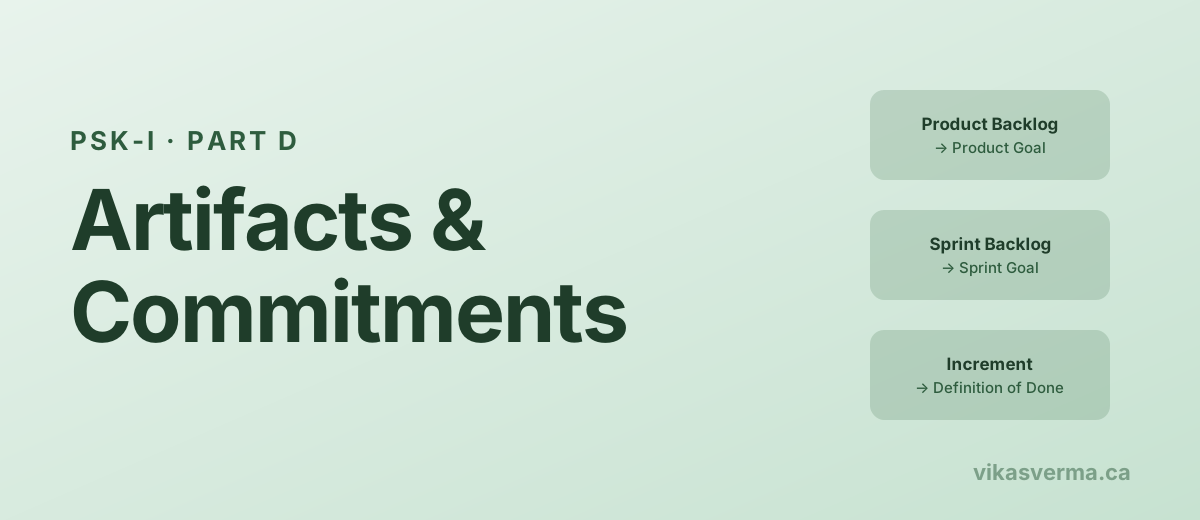
Scrum has three artifacts, each with exactly one commitment that brings transparency and focus to that artifact’s progress.
| Artifact | Commitment | The commitment answers… |
|---|---|---|
| Product Backlog | Product Goal | Where is the product going? |
| Sprint Backlog | Sprint Goal | Why is this Sprint valuable? |
| Increment | Definition of Done | Is the work actually finished and usable? |
Why this matters. Pre-2020, the Sprint Goal and “done” were loosely attached to artifacts. The 2020 Guide gave each artifact a named commitment so progress can be measured against something concrete — directly serving transparency.
The #1 artifact mistake on the exam: mixing up which commitment belongs to which artifact. Memorise the table above.
How questions come.
- “Match each artifact to its commitment.” → use the table above.
- “Which is a commitment, not an artifact?” → Product Goal / Sprint Goal / Definition of Done are commitments; the two backlogs and the Increment are artifacts.
D1. Product Backlog & Product Goal
What the Product Backlog is. An emergent, ordered list of what’s needed to improve the product — the single source of work. It is never complete; it evolves with the product and environment.
What the Product Goal is. The product’s future target state — a single, longer-term objective the team pursues one at a time. A team fulfils (or abandons) one Product Goal before the next.
Refinement. Items become “ready” through refinement — the ongoing activity of breaking down items and adding detail and order. Refinement is not an event and has no timebox. It happens continuously, not on a mandated schedule.
Key nuances.
- Ordering is the PO’s call; the Developers who’ll do the work typically size items.
- There is one Product Backlog per product, even with multiple teams.
- The team pursues one Product Goal at a time — pursuing two simultaneously is wrong.
Misconception to avoid. “Refinement is a mandatory, timeboxed event.” It’s an activity — continuous, flexible, and never a sixth Scrum event.
Worked example. A team treats “refinement” as a fixed 2-hour Friday meeting and calls it an event. That mislabels it — refinement is an ongoing activity; the team refines a little continuously, whenever it adds clarity.
How questions come.
- “How is Product Backlog refinement best described?” → an ongoing activity (not a formal, timeboxed event).
- “How many Product Goals at once?” → one.
- “What is the Product Backlog?” → an emergent, ordered, never-complete single source of work.
D2. Sprint Backlog & Sprint Goal
What the Sprint Backlog is.
Sprint Goal (why) + selected Product Backlog items (what) + an actionable plan to deliver them (how)
It is by and for the Developers — a real-time picture of the work they plan to do to meet the Sprint Goal; updated throughout the Sprint as they learn.
What the Sprint Goal is. The single objective giving the Sprint coherence and focus. Crafted in Sprint Planning as a whole-team commitment. It stays fixed for the duration of the Sprint.
The crucial distinction: scope vs Goal.
Scope can be clarified and renegotiated with the PO as more is learned — but the Sprint Goal stays fixed. This flexibility is how the team keeps the Goal intact while details shift.
Mid-Sprint changes. Belong to the Developers to manage. New work that would endanger the Sprint Goal should not enter the Sprint without explicit negotiation.
Misconception to avoid. “The PO adds items to the Sprint Backlog at will.” Changes are negotiated with the Developers, who own it.
Worked example. Halfway through, the Developers discover an item is bigger than thought. They renegotiate scope with the PO — drop a lower-value item — while keeping the Sprint Goal intact. The PO unilaterally injecting new items that threaten the Goal would be wrong.
How questions come.
- “What are the parts of the Sprint Backlog?” → Sprint Goal + selected items + plan.
- “As Developers learn more, what may change vs stay fixed?” → scope may be renegotiated; the Sprint Goal stays.
- “Who owns/updates the Sprint Backlog?” → the Developers, throughout the Sprint.
D3. Increment & Definition of Done
What an Increment is. A concrete stepping stone toward the Product Goal — it must be usable and verifiably meet the Definition of Done.
Key mechanics.
- Each Increment adds to prior Increments and is verified to work with them.
- An Increment is “born” the moment an item meets the DoD — so multiple Increments can exist within one Sprint, not just one at Sprint end.
- Releasing is separate from being Done: the Increment must be usable, but the decision to release is the PO’s — releasing every Sprint is not required.
What the Definition of Done is. The formal description of the state the Increment must reach to be considered complete and usable. It creates transparency about quality — one shared meaning of “done.”
Organisational DoD rules.
- If an org DoD exists, it is a minimum all teams must meet.
- A team may make it stricter, never weaker.
- If no org DoD exists, the team creates one.
- Multiple teams on one product share the same DoD.
When an item doesn’t meet the DoD. It cannot be released or presented as done. It returns to the Product Backlog.
Misconception to avoid.
- “One Increment per Sprint.” No — potentially many.
- “A team can relax the org DoD.” No — only stricter.
- “The Increment must ship each Sprint.” No — the PO decides.
Worked example. The org DoD requires automated tests + security scan. A team wants to also require a performance benchmark. That’s allowed (stricter than the minimum). Skipping the security scan “just this Sprint” is not allowed — the work isn’t Done and goes back to the Product Backlog.
How questions come.
- “An org DoD exists; can a team add stricter checks?” → Yes (exceed the minimum, never weaken).
- “An item doesn’t meet the DoD at Sprint end.” → back to the Product Backlog, not shown as done.
- “How many Increments in a Sprint?” → one or more (born when an item meets the DoD).
- “Must the Increment be released each Sprint?” → No — usable yes; releasing is the PO’s call.
Next: Part E — Kanban Core — the definition of Kanban, its relationship to Scrum, the four practices, the Definition of Workflow, WIP limits, and pull systems.